How to Choose the Best Louvre Roof for Your Project
Choosing a Louvre Roof is not just a style decision. It affects shade, daylight, ventilation, drainage, and how comfortably a terrace works through changing weather. Climate data helps explain why local conditions deserve close attention. NOAA’s 2023 Annual Climate Report found that global temperatures that year were 1.18°C above the twentieth-century average. The IPCC’s Sixth Assessment Synthesis Report estimates human-caused warming reached about 1.1°C in 2011–2020, compared with 1850–1900. These figures describe broad trends, not the weather at your address. Still, they make one point clear: a roof should be chosen for its actual site, not a showroom photograph.
Begin with practical questions. Does the project face strong afternoon sun? How often do heavy showers arrive, and where can rainwater drain safely? What wind exposure, span, and building structure must the system handle? For useful answers, compare product specifications with local climate records and seek advice from a qualified designer or installer. Check louvre material, blade movement, controls, drainage details, maintenance needs, and warranty terms. A motorized system may be convenient, but convenience alone does not guarantee suitable performance. That matters.
A good shortlist balances appearance with measurable requirements. Ask suppliers for documented wind and water performance, installation guidance, and clear limits for each configuration. Verify that the proposed dimensions and fixing method suit your structure. I would not treat a single rating as proof that every installation will perform equally well; workmanship and exposure matter, too. This guide explains how to compare options without overlooking those details. Sometimes the best choice is less dramatic—and more dependable.
Define Site Wind and Snow Loads Using ASCE/SEI 7-22
For a louvre roof, start with the site—not a generic “wind-rated” product claim. ASCE/SEI 7-22 sets the framework for determining design wind and snow loads. Its wind assessment considers risk category, mapped wind speed, exposure, topography, and enclosure conditions. A roof beside open water may face Exposure D, while nearby buildings and trees can affect exposure classification. Small site details matter.
Use the standard’s site-specific hazard data, then account for the roof’s actual geometry and operation. Wind pressure can change when louvers are open, closed, or partially rotated. Snow design should include ground snow load, roof slope, thermal conditions, and drift near walls or higher roof sections. Don’t assume moving louvers remove the snow risk. They may not. A qualified structural engineer should confirm the applicable coefficients and load combinations; unusual assemblies may need project-specific testing.
Weather losses underline why estimates deserve care. NOAA’s 2023 Billion-Dollar Weather and Climate Disasters report recorded 28 U.S. events, with estimated losses of $92.9 billion. Those figures are not design loads, but they show how costly severe weather can become.
Confirm the project address, elevation, surrounding terrain, and local snow history before selecting a system. A map lookup is a start, not the whole calculation.
Sources: ASCE/SEI 7-22; NOAA National Centers for Environmental Information, 2023 report.
Compare 6063-T5 Aluminum Profiles and Manufacturer-Tested Span Limits
6063-T5 aluminum is commonly used for louvre roof profiles because it combines useful strength with good formability. The alloy alone does not determine how far a beam can span. Profile depth, wall thickness, connections, and support spacing all matter. Ask for test data tied to the exact profile and roof configuration you are considering. Not just a brochure figure. Check whether the stated limit refers to a beam, blade, or complete assembly. These are different components, and their span limits are not interchangeable.
Manufacturer-tested limits are most useful when the test conditions resemble your project. Confirm the assumed wind and other design loads, fixing details, and permitted deflection. A profile tested with closely spaced supports may not perform the same across a wider opening. For example, a patio beam spanning a broad doorway needs evidence for that spacing, not a nearby size from a table. I would be cautious about treating a maximum span as a target. A modest safety margin can help accommodate site measurements and installation tolerances. Check the report, too; a neat summary table may omit the details that change the result. Ask a qualified structural professional to review the proposed layout and site conditions before ordering.
Assess Finish Durability Against AAMA 2604 and 2605 Standards
How to Choose the Best Louvre Roof for Your Project
Assess Finish Durability Against AAMA 2604 and 2605 Standards
When comparing louvre roof finishes, treat AAMA 2604 and AAMA 2605 as coating benchmarks, not whole-roof guarantees. AAMA 2604 covers high-performance organic coatings; 2605 sets more demanding criteria for coatings exposed to severe weathering. The difference matters where louvers face strong sun, coastal moisture, or frequent cleaning. Ask for test documentation matching the exact coating, color, and metal substrate. A sample chip can look convincing indoors. It tells little about years of UV exposure.
Tips: Check the specified standard, coating type, pretreatment, and warranty exclusions. Confirm that documentation names your selected color. Dark finishes may show heat and fading sooner. Keep a small offcut for later comparison.
A 2605-rated finish may suit exposed sites or longer service expectations, while 2604 can be appropriate in milder conditions. Neither rating replaces sound drainage, compatible fasteners, and routine rinsing. Salt and trapped debris can attack edges and joints first. Read the specification carefully: a rating may apply only to the coating system under defined test conditions. Not a roof warranty. It does not certify louvre strength, moving parts, or installation quality. Compare lifecycle needs, not just the highest number. Maintenance assumptions are easy to underestimate, so ask for test reports and clarify how repairs affect coverage.
How to Choose the Best Louvre Roof for Your Project – Assess Finish Durability Against AAMA 2604 and 2605 Standards
| Assessment dimension |
AAMA 2604 |
AAMA 2605 |
What it means for a louvre roof |
| Standard category |
Performance specification for high-performance organic coatings on architectural aluminum. |
More stringent performance specification for superior-performing organic coatings on architectural aluminum. |
Both are relevant benchmarks for coated aluminum components; confirm that the specified finish system is tested to the applicable standard. |
| Weathering exposure |
Includes accelerated weathering and South Florida outdoor exposure requirements; commonly associated with a 5-year outdoor exposure category. |
Uses more demanding weathering performance requirements and a longer South Florida outdoor exposure category, commonly 10 years. |
For strong, prolonged sun exposure, 2605 offers a higher performance benchmark. Exposure categories are test requirements, not a promise of service life. |
| Color and gloss retention |
Sets limits for color change and chalking after specified weathering exposure. |
Applies more demanding weathering criteria for color and chalking performance. |
Consider 2605 where visible fading or chalking would be especially undesirable, such as on prominent roof blades or façades. |
| Corrosion resistance |
Includes corrosion-resistance testing for the coating system. |
Requires more demanding corrosion performance than 2604. |
For coastal, humid, or pollution-exposed sites, prioritize the specified pretreatment and complete coating system as well as the standard rating. |
| Resistance to film damage |
Includes requirements for coating properties such as adhesion and resistance to physical damage. |
Includes more stringent requirements for coating performance, including resistance to physical damage. |
Ask how the finish is protected during transport and installation; scratches or cut edges can compromise protection regardless of the rating. |
| Typical project fit |
A potential fit for many architectural applications with moderate exposure and a balanced performance-and-cost brief. |
A potential fit for demanding exposure, high visibility, or projects seeking a higher coating-performance benchmark. |
Select based on site conditions, appearance expectations, maintenance plan, and verified product documentation—not on the standard number alone. |
| Information to verify |
Request documentation identifying the coating system, substrate, pretreatment, applicable standard and test results. |
Request the same documentation and confirm the claim applies to the exact finish and product configuration being supplied. |
AAMA ratings describe coating performance under defined tests. They are not warranties; warranty coverage and service life depend on the supplier’s terms, installation, exposure, and maintenance. |
Match Motor Weather Protection to IEC 60529 IP Ratings
For a louvre roof, match the motor’s IP rating to its actual exposure, not just the product brochure. IEC 60529 defines the IP code: the first digit indicates protection against solid objects, while the second covers water. For example, IP55 means dust-protected and tested against water jets. IPX4 covers splashing water; IPX5 covers water jets. These are different test conditions, not a simple “weatherproof” scale. Check the motor, junction box, and control enclosure separately.
Think about where water will travel. A motor beneath an overhang may face less direct spray than one near an exposed roof edge, but wind-driven rain can still reach cable entries. IEC 60529 does not rate resistance to UV exposure, corrosion, condensation, or every real-world installation detail. A higher IP number is not a complete design answer. Confirm the manufacturer’s test documentation and installation limits, then consider drainage, cable glands, and maintenance access. A rating can look reassuring on a submittal; the weak point may be the connector beside it. One detail often missed.
How to Choose the Best Louvre Roof Motor Weather Protection
Compare the water-protection levels in the second digit of an IEC 60529 IP rating. Select a motor rating that suits its exposure and installation conditions, and confirm the rating with the motor manufacturer.
Reading the chart: IPX ratings describe water protection only; “X” means the enclosure’s solid-particle protection is not specified here. The levels are categories, not a linear performance scale. For example, IP54 combines dust protection level 5 with water protection level 4.
Check Drainage Capacity Against Local Design Rainfall Data
Use local design rainfall data, not annual averages. Ask the project’s engineer or local authority which storm intensity and duration apply. Return periods and design rules vary by location. For a preliminary check, estimate peak flow with Q = i × A × C ÷ 3600, where i is rainfall intensity in millimetres per hour, A is the contributing area in square metres, and C is a runoff factor. The result is litres per second. It is only an estimate.
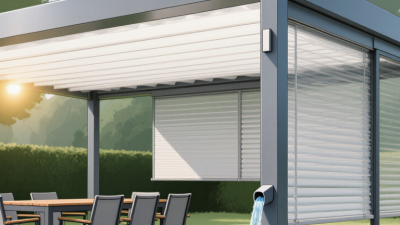
For a louvre roof, confirm how much rain reaches the gutters when the blades are open. The closed-roof area may not tell the whole story. Check the capacity of gutters, outlets, and downpipes as one system, including bends and long runs that can slow discharge. Leave a practical margin for leaves and debris. Small details matter. Provide a visible overflow route so water does not collect against doors or flow into occupied areas. A hose test can reveal leaks or poor falls, but it cannot replace a calculation using local rainfall data. Even careful assumptions can miss wind-driven rain, so review the drainage layout against the actual site exposure.