Leave Your Message

China Top Louvre Roof Manufacturers for Global Buyers

Choosing a China-based Louvre Roof manufacturer involves more than comparing prices or attractive product photos. Global buyers need to assess design capability, materials, production controls, communication, and after-sales support. A roof may look simple in a catalogue. Its performance depends on details such as blade alignment, frame rigidity, drainage paths, and motor protection.

This guide introduces key considerations for identifying manufacturers and evaluating their claims. It explains how to compare aluminium specifications, finishes, opening mechanisms, control options, and project customization. Buyers should request current product documentation, clear warranty terms, and evidence of relevant quality checks. Ask how the supplier handles samples, packaging, shipping schedules, and replacement parts. Small questions matter.

A company’s brochure alone is not proof of consistent production. Where possible, review recent project references and confirm which services the manufacturer provides directly. Some suppliers may rely on outside partners for components or installation; that is not automatically a problem, but it should be disclosed. No shortlist is perfect. Requirements differ by climate, building type, and project budget, so a suitable supplier for one buyer may not fit another. Use the comparisons in this article as a starting point, then verify details with each manufacturer before making a purchasing decision.
China Top Louvre Roof Manufacturers for Global Buyers

What Defines a Louvre Roof: Blades, Frames, Motors, and Drainage

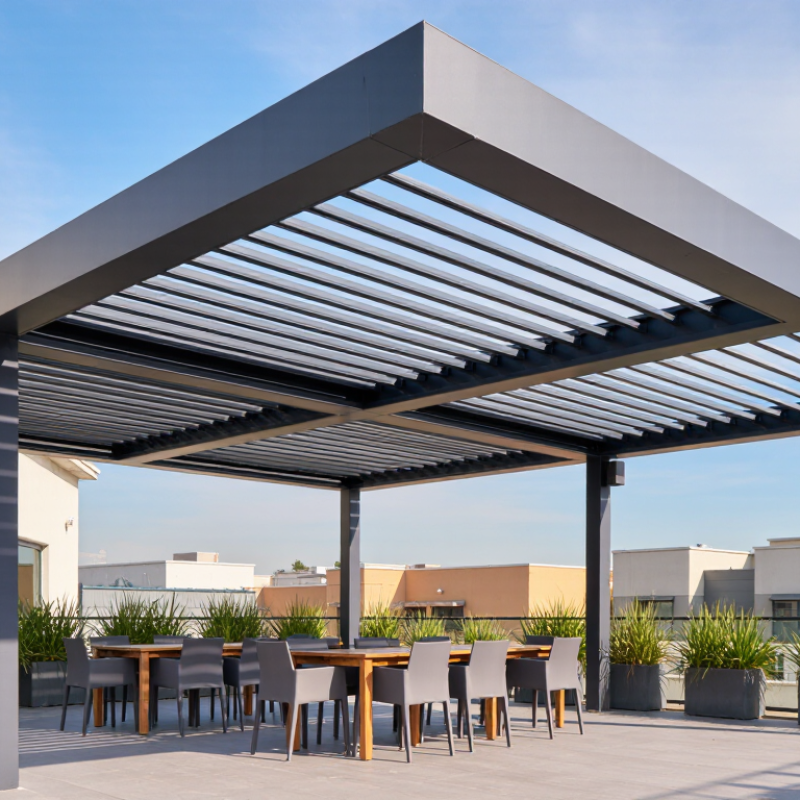
A louvre roof is more than a row of tilting blades. It is a coordinated weather-control assembly. Blade shape, overlap, and pivot spacing affect sunlight, airflow, and rain paths. Deep blades can create strong shade, but may also reduce daylight or collect leaves. Small details matter. Ask for documented wind-load limits and evidence that seals stay aligned through repeated operation. Frame sizing should match the span, local exposure, and supporting structure—not just the roof’s appearance.

Motors need enough torque for the installed blade area, with accessible wiring and service access. Specify cycle testing, overload protection, and a clear plan for power failures. Drainage is equally practical: channels should direct water to outlets, not doorways. Check outlet capacity against local rainfall data. In the United States, NOAA Atlas 14 provides location-specific precipitation-frequency estimates. The weak point is often the overlooked outlet. The UNEP 2024/2025 Global Status Report for Buildings and Construction links the sector to 32% of global energy use and 34% of energy-related CO₂ emissions. Shading may help reduce cooling demand, but actual savings depend on climate, controls, and occupant behavior.


How to read this chart: Bars count typical primary functions listed for each component; they are not performance ratings. Actual capabilities vary by system design.

How 0–135° Blade Rotation Affects Sunlight, Ventilation, and Rain Control

A louvre roof’s 0–135° range is useful only when the blade position is understood in relation to its hinge and the sun. Near a closed setting, blades can block direct sunlight and reduce rain entry, but they may also dim the space beneath. At wider openings, daylight and airflow increase. Angles are not magic. A west-facing patio may still receive low evening sun through partly open blades.

Ventilation depends on more than blade angle. Wind direction, roof height, and the size of the opening all matter. The International Energy Agency’s 2023 Global Status Report for Buildings and Construction reports that buildings account for about 30% of global final energy use. That figure does not predict savings from a louvre roof, but it shows why passive shading and airflow deserve careful design. For rain control, partly open blades may shed light showers, yet wind-driven rain can pass through. Test settings under local conditions.

For buyers comparing roof systems, ask for drawings showing blade angles, drainage paths, and operating limits. Check whether the control system allows small adjustments, not just fully open or closed positions. I would not treat one angle as a fixed recipe. The best setting changes with season, wind, and the table below. And real weather is messier. A brief site trial can reveal glare or splashing that product diagrams miss.

How to Check Wind and Snow Loads Under EN 1991 Design Rules

For a louvre roof, wind and snow checks should start with the project location, roof geometry, and intended use. EN 1991-1-4 guides wind actions, while EN 1991-1-3 covers snow loads. The applicable National Annex matters because local parameters can differ. Record the building height, terrain exposure, nearby obstructions, and roof slope. Small gaps matter. Airflow through the blades may affect pressure on the roof and its supports, so a solid-roof assumption should not be made without review. Check the blades, rails, fixings, columns, and connections as one load path.

Snow needs equal care. Consider both a broadly even layer and uneven accumulation, especially beside parapets, raised equipment, or changes in roof level. A site’s altitude and local snow conditions can influence the design values. Ask the supplier for drawings, material specifications, and calculations that show how loads reach the supporting structure. Then have a qualified structural engineer check the assumptions against the site and relevant National Annex. A polished table is not proof by itself. I have seen small geometry details get missed; that is exactly where a second review helps. If the roof is unusually open or sheltered, document why the selected load model is appropriate.

How to Assess Chinese Manufacturers: ISO 9001, Testing, and Factory QA

China Top Louvre Roof Manufacturers for Global Buyers

For global buyers, a manufacturer’s ISO 9001 certificate is a starting point, not proof of product quality. Check that it is current, covers the relevant production site, and applies to the manufacturing activities you are buying. Ask how nonconforming parts are recorded and corrected. Details matter.

Factory QA should be visible in routine work. Look for incoming material checks, documented dimensions, and batch traceability from sheet metal to finished louvre panels. Ask staff to show a recent inspection record, not only a polished quality manual. A clear answer matters.

Testing deserves the same scrutiny. Request reports for relevant performance, such as air movement, water penetration, or wind resistance, and confirm the tested configuration matches your proposed design. Louvre blade spacing, frame size, and installation details can change results. Check who conducted the test and when. Not just paperwork.

A video call can show measuring tools, assembly stations, and finished goods, but it cannot replace an independent inspection when project risk is high. Compare sample units with approved drawings, including coating finish and actuator fit where applicable. If a supplier cannot explain a failed test or a changed material, pause and ask for evidence. Supplier documents can be incomplete; that is worth noting, not ignoring.

China Top Louvre Roof Manufacturers for Global Buyers - How to Assess Chinese Manufacturers: ISO 9001, Testing, and Factory QA

Assessment Dimension What Buyers Should Verify Useful Evidence to Request Suggested Weight
ISO 9001 quality management Check that the certificate is current, covers the relevant manufacturing activities and site, and was issued by a certification body whose accreditation can be independently verified. ISO 9001 certification is evidence of a quality management system, not a product-performance guarantee. Certificate number, issuing and accrediting body, scope, covered site, validity dates, and a current verification record from the certification body or an appropriate directory. 15 points
Factory quality assurance Assess incoming-material checks, in-process inspections, final inspection, nonconformance handling, corrective actions, and whether inspection records are traceable to production batches. Redacted inspection forms, inspection and test plans, sample nonconformance/corrective-action records, calibration records, and a live or recorded factory audit. 15 points
Structural and wind-load assessment Confirm that calculations and any physical tests reflect the proposed dimensions, support conditions, louver configuration, materials, and project design loads. Do not assume one result applies to every size or installation. Project-specific calculations, test setup and results where applicable, design assumptions, allowable limits, and signed review by a qualified engineer where required by the project. 15 points
Water management and leakage testing Review how the system sheds water, manages gutters and outlets, and performs at joints and interfaces. Agree on the test method, specimen configuration, and acceptance criteria before testing; results depend on installation and exposure conditions. Test procedure and report, specimen drawings, observed leakage or drainage results, outlet details, and installation requirements for the tested assembly. 15 points
Materials and component traceability Match the specified alloy or material grade, wall thickness, fasteners, seals, motors, and electrical components to the approved drawings and purchase specification. Verify substitutions are controlled and approved. Material certificates where applicable, supplier declarations, incoming inspection records, component schedules, and batch or serial-number traceability. 10 points
Coating and corrosion resistance Identify the substrate, pretreatment, coating system, film-thickness requirements, and inspection method. Select exposure and acceptance requirements for the project environment. Salt-spray results are comparative test data and should not be treated as a direct prediction of service life. Coating specification, pretreatment records, thickness readings, adhesion or other agreed test results, and the applicable test method and acceptance criteria. 10 points
Actuation and electrical controls For motorized systems, check operating limits, control compatibility, wiring and enclosure requirements, safety provisions, and behavior under the specified operating conditions. Confirm relevant electrical compliance for the destination market. Motor and control datasheets, wiring diagrams, functional-test records, applicable declarations or certificates, and installation and maintenance instructions. 10 points
Documentation, delivery, and after-sales support Evaluate drawing approval, change control, packaging, spare-parts availability, warranty terms, installation guidance, and response procedures for defects or claims. Document register, approved production drawings, packaging plan, written warranty, spare-parts list, service process, and a sample shipment inspection checklist. 10 points
Suggested total score 100 points

Scoring note: Apply the same evidence-based criteria to every supplier. Award points for verified, relevant documentation and witnessed or independently reviewed results; mark unavailable or out-of-scope evidence for follow-up rather than treating it as a confirmed pass. Final test requirements and acceptance limits should be agreed for the project, destination market, and installation conditions.

How Global Buyers Compare Specifications, Lead Times, and Incoterms

When comparing China-based louvre roof manufacturers, send each supplier the same specification sheet. Include opening dimensions, blade material and finish, drainage direction, motor type, and required wind-load data. Ask how the figures were tested and request drawings or reports that match the proposed configuration. A polished quotation is not proof that two systems perform alike.

Details matter. A small change in blade span can affect support spacing and operation. Compare quoted lead times by stage: engineering approval, production, packing, and transport. Ask what starts the production clock, and whether custom colors or revised drawings add days. Buyers often compare only the earliest shipping date. That can be misleading.

Incoterms need the same careful reading. Compare the named rule, version, and delivery place on every quotation. FOB and DAP assign different transport tasks, costs, and points where risk transfers; confirm who arranges insurance and handles import clearance under the agreed term. Get the allocation in writing. I have seen spreadsheets miss this distinction, even when prices looked directly comparable. A clear comparison may feel slower, but it exposes gaps before an order is placed.